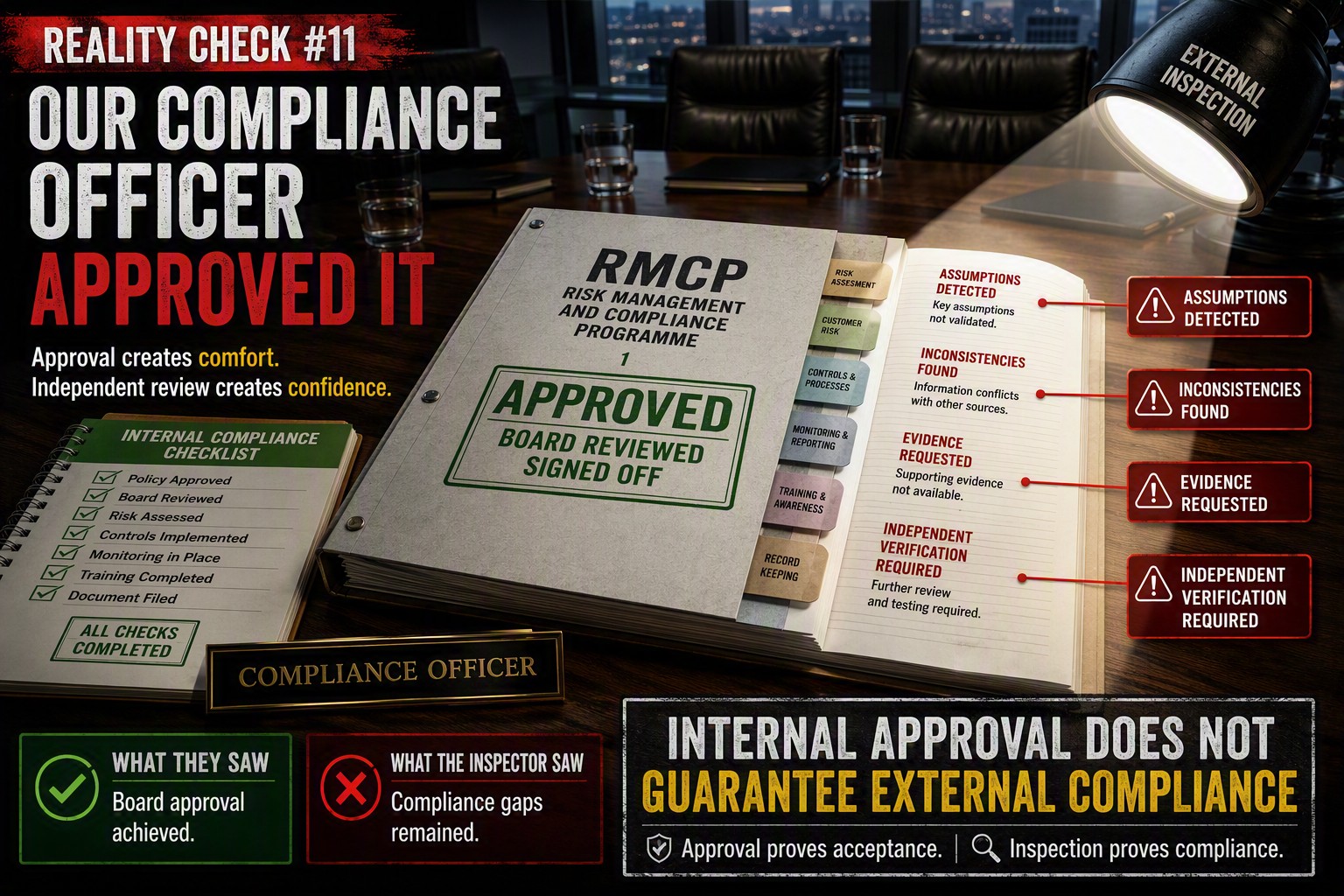
Reality Check #11
Our Compliance Officer Approved It.
That was the reassurance.
The RMCP existed.
The review had been completed.
The file had been approved.
The document had been distributed.
The matter was considered closed.
Then reality arrived.
An independent review was conducted.
Questions appeared.
Gaps appeared.
Weaknesses appeared.
Assumptions appeared.
The confidence remained.
The compliance did not.
The most dangerous words in compliance are often:
"We have an RMCP."
The words create comfort.
They create reassurance.
They create a feeling that the matter has been dealt with.
The RMCP exists.
The file is there.
The document has been signed.
The document has been approved.
Therefore everything must be fine.
That assumption becomes surprisingly powerful.
People stop asking questions.
People stop testing.
People stop comparing.
People stop challenging.
The RMCP becomes accepted truth.
Until it is forensically reviewed.
That is often the moment everything changes.
The comfort starts disappearing.
The assumptions start appearing.
The inconsistencies start appearing.
The gaps start appearing.
The confidence starts colliding with reality.
Forensic review is different.
It does not ask:
"Do you have an RMCP?"
It asks:
"Does the RMCP support the business?"
"Does the RMCP support the RCR?"
"Does the RMCP support the evidence?"
"Can the controls be demonstrated?"
"Can the processes be demonstrated?"
"Can the risks be justified?"
Many businesses become exposed here.
The RMCP passed the internal test.
It passed the Compliance Officer's test.
It passed management's test.
It passed the comfort test.
Then it met an independent review.
The result was very different.
This does not automatically mean the Compliance Officer lacks competence.
It means familiarity creates blindness.
The closer people are to a document, the harder it becomes to see its weaknesses.
Assumptions become facts.
Opinions become policy.
Processes become accepted.
The document stops being challenged.
That is where psychological resistance appears.
Not because people dislike compliance.
Because people become emotionally invested in the document.
Time was invested.
Money was invested.
Professional advice was obtained.
Approvals were granted.
The RMCP became part of the business identity.
When weaknesses are identified, it no longer feels like a document review.
It feels like personal criticism.
It feels like a challenge to previous decisions.
It feels like a challenge to previous advice.
It feels like a challenge to professional judgement.
That is why many people defend the document before examining it.
Then another assumption appears.
"We have a Compliance Officer."
Therefore:
"The RMCP must be compliant."
Those statements are not automatically connected.
The title does not create compliance.
The review process does.
The challenge process does.
The evidence does.
The irony is that the discomfort serves a purpose.
Discomfort is often the first sign that attention has finally reached the right place.
The moment discomfort appears, attention appears.
The moment attention appears, improvement becomes possible.
Before that moment, the RMCP often exists